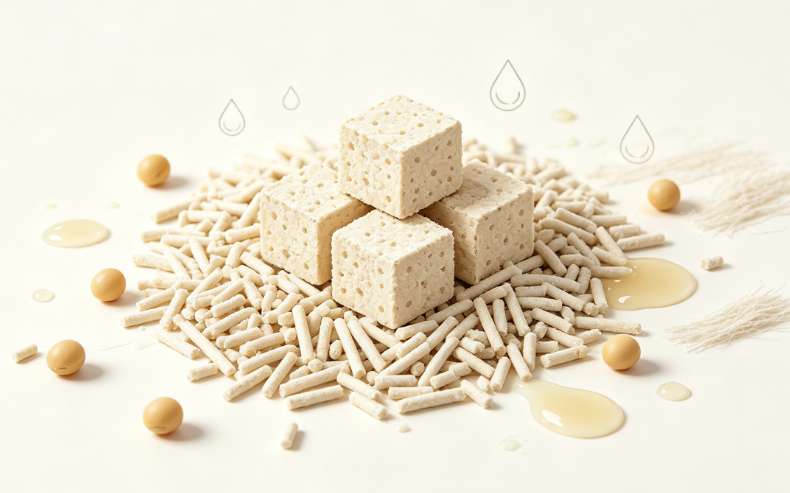
All cat litter brand merchants know clearly: clumping ability is the core competitiveness of tofu cat litter, which directly determines repurchase rates. Many private-label brands frequently receive after-sales complaints — loose clumps that break apart when scooped, urine leakage sticking to the litter box bottom, and muddy texture hard to clean. Few people realize that there are six key control points affecting the clumping effect of tofu cat litter, covering raw materials to finished production.
1. Protein Content of Soybean Dreg Raw Materials (Fundamental Core)
The adhesive power of tofu cat litter comes from soybean protein, and protein content directly decides clump compactness.
- Premium food-grade soybean dregs: Abundant plant protein makes particles expand evenly when contacting urine, fibers interlock to form hard, intact clumps that resist breaking during scooping.
- Cheap mixed outsourced raw materials: Small factories cut costs by mixing straw, expired low-protein soybean residues and miscellaneous fibers. Lacking natural adhesive protein, the litter forms soft, fragile clumps that crumble easily. This is a major OEM pitfall: high-purity soybean dregs are used for samples, while cheap inferior materials are switched for bulk orders, leading to a massive gap between sample and mass-production clumping performance.
2. Raw Material Moisture Content
Moisture acts as a critical balance factor for clumping performance:
- Optimal moisture content: 8%-12% — particles have moderate hardness, balanced water absorption speed, and rapidly form solid whole clumps.
- Excess moisture: Freshly produced particles are soft, turn into mud on contact with urine, and stick heavily to the tray base.
- Insufficient moisture: Brittle particles crack easily; ultra-fast water absorption prevents full fiber bonding, only producing tiny broken fragments. Source factories with self-owned supporting soybean dreg processing plants maintain stable raw material humidity all year round, eliminating inconsistent clumping across batches.
3. Dedicated Production Line Extrusion Molding Technology
Independent exclusive production lines for tofu cat litter are the hardware foundation for stable clumping: Fully automatic dedicated lines with high-pressure extrusion create dense internal fiber structures inside particles. Fibers crosslink and lock water upon contact with liquid, forming tight, sturdy clumps. Small factories sharing mixed production lines set equipment parameters for bentonite/cassava litter instead. Tofu particles are loosely molded with hollow interiors, shattering immediately after absorbing urine — an inherent flaw of shared-line OEM that cannot be fixed.
4. Post-molding Drying Temperature & Duration
Drying processes either preserve or destroy protein’s adhesive activity: Low-temperature uniform drying: Gradually removes excess moisture without damaging soybean protein, maintaining excellent long-term clumping capacity. High-speed high-temperature drying (a low-cost quality cutback): High heat denatures and deactivates protein, eliminating adhesive properties. Even with fast water absorption, clumps fall apart at the slightest touch.
5. Formula Ratios & Food-Grade Additives
Custom OEM formulas directly separate product grades:
- Pure original tofu litter: Only soybean dreg raw materials, mild and natural, ideal for kittens, moderate clumping speed for single-cat households.
- Enhanced clumping formula: Proper addition of food-grade cassava fiber boosts water locking and clump hardness, the top choice for multi-cat households and cats with heavy urine output.
- Cheap filler formula: Large amounts of coarse fiber waste reduce protein proportion, sacrificing clumping performance to slash production costs.
6. Finished Product Storage & Transportation Moisture-Proof Conditions
Even high-quality tofu cat litter loses all clumping performance once dampened: Humid warehouses or sea freight without moisture-proof packaging cause litter to absorb ambient moisture in advance, saturating internal water absorption spaces. The litter cannot lock liquid and form clumps when cats urinate. Formal source OEM manufacturers all use thickened moisture-proof packaging bags suitable for long-distance cross-border sea shipments and long-term stock storage.
Dedicated-Line Source Factories Eliminate Unstable Clumping at the Root
Inconsistent clumping across OEM batches on the market stems from two core pain points: shared production lines and fluctuating quality of outsourced raw materials. Full-process standardized control covers raw material protein level, moisture content, extrusion pressure and drying time. Every batch of tofu cat litter delivers identical clumping speed and compactness, completely solving the OEM headache of mismatched quality between samples and bulk goods.
FAQ
Q1: Does unscented tofu cat litter clump better than scented variants? A: Low-concentration fragrances do not interfere with clumping performance. Raw material protein and drying process remain the core determining factors. Q2: Why does the same bag of litter clump well at first but get worse over time? A: Insufficient moisture resistance of packaging allows continuous absorption of airborne humidity during use, gradually reducing water-absorbing adhesion capacity. Q3: Does cassava-blended tofu litter clump stronger than pure tofu litter? A: Formulas mixed with cassava fiber offer superior water locking and harder clumps, more suitable for multi-cat families and hot, humid regions.
